
Advanced Tools for Boosting Productivity in Go-lang
By Tarun Nahak

Introduction
In recent years, Go has risen in popularity as a powerful language for backend and cloud-native applications. While many developers are aware of Go’s fundamental tools (go run, go test, go fmt, etc.), fewer know about the advanced tools that can supercharge productivity and elevate the quality of Go applications. This article will introduce a curated list of advanced tools that cover various stages of the Go development lifecycle, from dependency management to code analysis, testing, and performance optimisation.
By integrating these tools, Go developers can speed up workflows, catch issues early, and fine-tune applications for better performance. Whether you’re building high-scale micro-services or diving into Go for your next project, these tools will help you get the most out of the Go ecosystem.
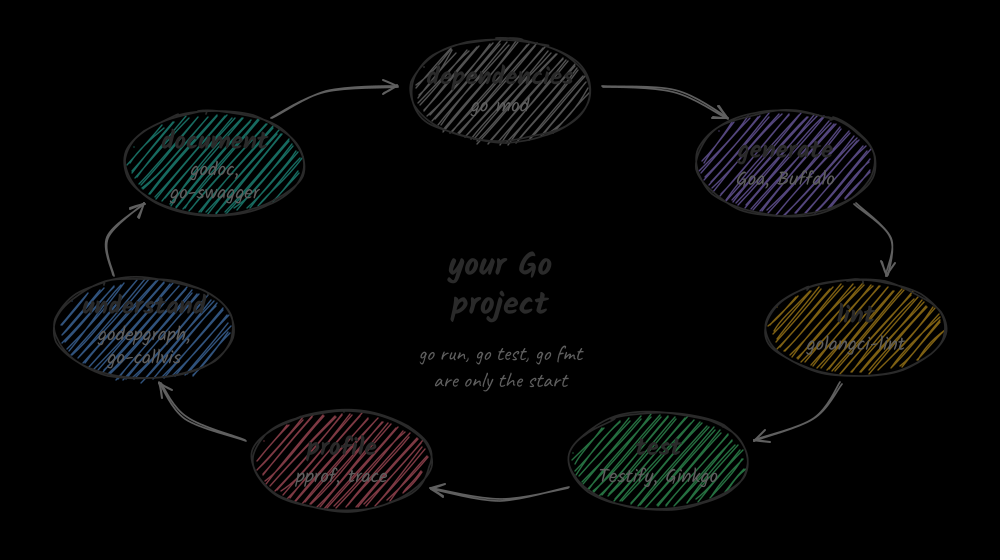
1. Dependency Management: Go Modules and Gopkg.lock
Go Modules, introduced in Go 1.11, is the go-to (pun intended) dependency management system for Golang. While Go Modules is familiar to many, understanding advanced usage of go.mod and go.sum can simplify complex projects.
- Go Modules Basics: go mod init initialises a module, while go mod tidy cleans up dependencies.
- Advanced Tips: Use go mod vendor to create a local vendor folder, ensuring dependencies are locked and offline-ready for CI/CD pipelines.
- Version Control: Tools like modver can help validate version constraints, avoiding potential dependency issues.
Beyond Go Modules, some developers find gopkg.lock (from dep) helpful for legacy projects. Using these alongside Go Modules can provide finer control over dependencies in mono-repos or legacy codebases.
2. Code Linting and Static Analysis: golangci-lint
Writing clean, maintainable code is critical, and linting tools help enforce best practices. golangci-lint is one of the most powerful tools for Go, offering static analysis and linting with minimal configuration.
- Why golangci-lint? It combines multiple linters (like errcheck, gosimple, unused) into a single tool, making it easy to catch potential issues.
- Features: Supports custom rules, plugins, and inline //nolint comments for more control.
- Performance: golangci-lint caches results and uses concurrent processing, which makes it faster for large projects.
To integrate, simply run golangci-lint run in your terminal, or configure it in CI/CD pipelines to catch errors before code merges.
3. Advanced Testing: Testify and Ginkgo
Testing is crucial in production-grade code, and while the standard library’s testing package is robust, tools like Testify and Ginkgo take testing in Go to the next level.
- Testify: Offers powerful assertion libraries (assert, require) and mock creation, making it ideal for writing expressive tests. It’s a lightweight addition to the standard testing package and fits well in unit testing workflows.
- Ginkgo: For behavior-driven development (BDD), Ginkgo provides a framework that allows structuring tests in a more expressive way. Use Gomega, an assertion library built for Ginkgo, to create readable, intention-driven tests.
These tools enhance test readability and make writing, organising, and managing tests more efficient, especially for complex projects.
4. Profiling and Performance Optimization: pprof and trace
Optimizing Go code is crucial for high-performance applications, and pprof is Go’s built-in tool for profiling CPU, memory, and goroutine performance.
- CPU and Memory Profiling: By adding import _ "net/http/pprof" and enabling it in your app, you can visualize CPU and memory usage in real time.
- Flame Graphs: pprof integrates with tools like go-torch to generate flame graphs, making it easy to identify bottlenecks.
- Tracing: Go’s trace package provides a lower-level analysis of goroutines, system calls, and scheduling events. It’s useful for diagnosing hard-to-track concurrency issues in production environments.
These profiling tools are crucial for developers focused on high-performance applications and can quickly reveal inefficient code paths.
5. Package Management and Dependency Analysis: godepgraph and go-callvis
Understanding dependencies and code structure is essential for maintainability. godepgraph and go-callvis are two visualization tools that make it easy to analyze and improve code organization.
- godepgraph: Generates dependency graphs that help understand module-level relationships and detect dependency cycles.
- go-callvis: A tool for visualizing function calls and package interactions within a Go program. Ideal for understanding complex interactions, go-callvis generates call graphs that clarify which functions interact and where.
These tools are invaluable for debugging and can provide insight into potential architectural improvements.
6. Code Generation: Goa and Gobuffalo
In projects that require a lot of boilerplate code, code generators save time and reduce errors.
- Goa: A framework for creating RESTful microservices with a design-first approach. Define API contracts, and Goa will generate corresponding server code.
- Gobuffalo: Primarily known as a web framework, Gobuffalo includes a code generation CLI that creates boilerplate code for web components, middleware, and services.
Using code generation tools reduces the amount of repetitive code you need to write, especially useful in micro-services and REST API projects.
7. Documentation and Code Browsing: godoc and GoSwagger
Documentation is key to maintainability, and Go offers built-in and third-party tools to keep it streamlined.
- godoc: Go’s built-in documentation generator, which serves as a mini web server, letting you browse package documentation locally.
- GoSwagger: For APIs, GoSwagger reads OpenAPI definitions and generates Go code for clients and servers, making it easier to keep documentation synchronized with code.
These tools improve code comprehension and are essential for onboarding and maintaining code quality.
Conclusion
With these advanced tools, Go developers can tackle complex challenges, optimise their workflows, and produce high-quality code. From dependency management to code generation and profiling, these tools cover every aspect of the development cycle. By leveraging these tools effectively, developers can build more robust, scalable, and efficient applications with Go.
Explore the possibilities and start integrating these tools into your workflow. The Go ecosystem is ever-evolving, and by staying updated with the latest tools, you can ensure that your Go projects are built for the future.
Originally published on Medium.