
Golang and Scalability: Building High-Performance Systems
By Tarun Nahak

Introduction
In today’s world of rapid tech growth, scalability is essential. Modern applications need to handle increasing traffic, complex data processing, and real-time demands without compromising performance. Golang, or Go, has emerged as a powerful tool for building scalable, high-performance systems. Its lightweight nature, efficient concurrency model, and simple syntax make it a go-to choice for backend development, cloud-native services, and microservices architectures.
This article delves into why Go is well-suited for scalable applications, exploring its core features, concurrency handling, garbage collection, and real-world examples from companies that rely on Go for their high-traffic systems. Whether you’re starting with Go or looking to deepen your understanding of its scalability strengths, this article offers insights and best practices for leveraging Go in scalable system design.
1. Why Go is Designed for Scalability
Go was designed by Google engineers for large-scale systems. It emphasizes simplicity and speed, with specific features that make it ideal for scalable architecture:
- Lightweight Goroutines: Goroutines are Go’s method for handling concurrency. Unlike traditional threads, they are lightweight and don’t require large memory allocation, which allows you to manage thousands or even millions of concurrent tasks.
- Efficient Garbage Collection: Go’s garbage collector is optimized for concurrent workloads. It reduces memory leaks by reclaiming unused memory, which is crucial for long-running applications that handle a lot of traffic.
- Minimalist Syntax: Go’s simple syntax improves readability and maintainability, which is essential for scaling projects and teams.
- Compilation Speed: Go’s compiler is fast, allowing developers to quickly iterate and deploy, which is valuable in high-growth environments.
With these foundational features, Go helps companies develop applications that can scale both in terms of performance and development agility.
2. Concurrency and Parallelism in Go
Concurrency is a cornerstone of scalability, and Go’s concurrency model is one of its standout features.
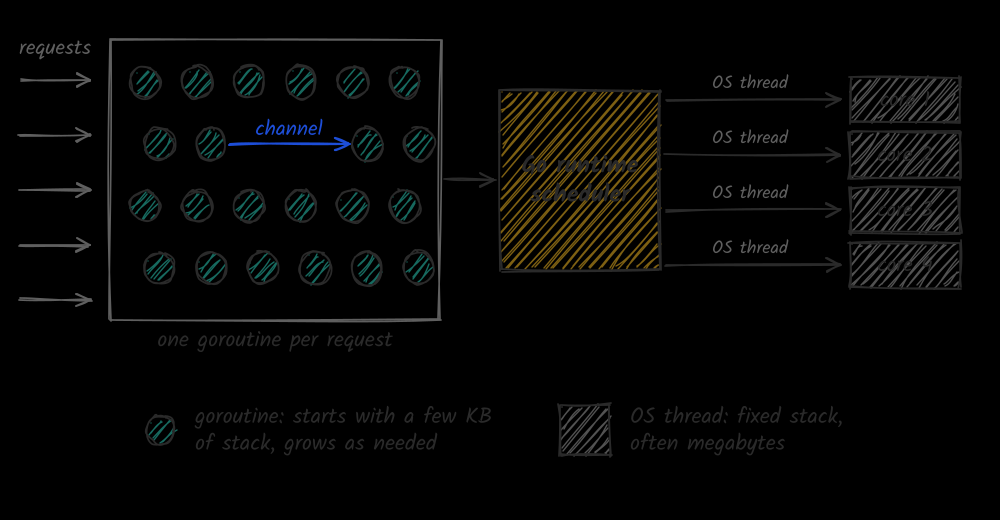
- Goroutines and Channels: Goroutines are functions that run independently of the main thread, allowing applications to handle numerous tasks concurrently. Channels provide a means of safe communication between goroutines, enabling structured concurrency that prevents common issues in multithreaded programming.
- Cost-Effective Parallel Processing: Unlike languages that rely on OS-level threads, goroutines are managed by Go’s runtime. This lowers the cost of context-switching, reducing the overhead of running multiple tasks and making parallel processing efficient for applications with large workloads.
- Practical Example: In a web server, each request can be handled by a separate goroutine. This allows the server to handle thousands of requests simultaneously without stalling, providing a seamless experience for users even during high-traffic periods.
By adopting Go’s concurrency tools, developers can build systems that handle concurrent tasks efficiently, meeting high demand without increased complexity or resource consumption.
3. Real-World Scalability with Go: Case Studies
Numerous tech giants use Go to scale their applications to millions of users. Let’s explore some notable examples:
- Google: Google uses Go for many of its internal systems, given Go’s strong support for high-performance, concurrent applications. Services like Kubernetes also rely on Go, demonstrating its effectiveness in handling complex, distributed systems.
- Uber: Uber chose Go to build its geofence service. Go’s low-latency concurrency allowed Uber to handle location-based traffic efficiently, ensuring ride requests and driver availability updates are processed in real time.
- Dropbox: Dropbox migrated to Go for its backend infrastructure, leading to more manageable code and improved performance. Go’s simple syntax helped Dropbox developers enhance team productivity as they scaled the service.
- Netflix: Netflix uses Go for tasks that require high concurrency, such as handling network operations in its streaming services. Go’s lightweight concurrency allows Netflix to manage numerous simultaneous connections, providing smooth streaming experiences.
These examples illustrate how Go’s concurrency, simplicity, and performance have enabled some of the most popular and high-traffic services to scale effectively.
4. Scalable Patterns and Practices in Go
Building a scalable application with Go requires adopting design patterns and best practices that suit its strengths. Here are a few key patterns:
- Microservices: Go is widely used for microservices due to its performance and modularity. Each service can run independently, making it easier to scale horizontally by adding more instances as demand grows.
- Load Balancing and Caching: Implement caching mechanisms and load balancers to distribute the workload across multiple services. This optimises resources, enabling systems to handle increased load without downtime.
- Graceful Shutdowns and Signal Handling: Gracefully shutting down services is crucial for scaling applications in production. Using context and signal packages in Go, developers can manage shutdowns, preventing abrupt service interruptions during high loads.
- Testing for Scalability: Performance testing tools like GoBench and GoTest help identify bottlenecks and optimize performance under load. Writing load tests allows developers to simulate real-world traffic and make adjustments before scaling applications in production.
With these patterns, you can create scalable Go applications ready to handle growth, adapt to demand, and maintain consistent performance.
5. Optimising Performance in Go for Scalability
Performance optimisation is crucial for scalability, and Go provides several tools and techniques to streamline this process:
- Profiling Tools: Go’s pprof tool can profile CPU, memory, and goroutine usage, allowing developers to identify bottlenecks. For more granular insights, the trace package can analyze function call times and memory allocations.
- Reducing Memory Leaks: Go’s garbage collection helps reduce memory leaks, but developers should still watch for resource-hogging patterns. For instance, using sync.Pool to reuse temporary objects can help minimise memory usage in concurrent applications.
- Optimising Network Calls: For microservices or web applications, optimising network calls using HTTP keep-alives and persistent connections can reduce latency. Additionally, using efficient JSON encoding/decoding libraries like easyjson can help handle large amounts of data without adding excessive latency.
These optimisations can ensure your Go applications maintain high performance as they scale, providing users with faster, more responsive services.
Conclusion
Go’s design philosophy, rooted in simplicity and efficiency, makes it an excellent choice for building scalable systems. Its concurrency model, efficient garbage collection, and straightforward syntax enable developers to build high-performance applications that grow alongside user demand. Companies like Google, Uber, Dropbox, and Netflix have harnessed Go’s capabilities to build and scale their services effectively.
Whether you’re building a microservice architecture, handling real-time data processing, or just starting with Go, embracing Go’s strengths and best practices will help you create scalable solutions tailored for today’s high-demand environment. The Go ecosystem is continually evolving, so keep exploring and optimizing as you scale your applications to new heights.
Originally published on Medium.