
Mastering Precision: Understanding PostgreSQL’s NUMERIC Type and How It Stands Out
By Tarun Nahak

When working with databases, accuracy and performance are pivotal, especially when handling numbers. PostgreSQL, a robust and versatile relational database, offers several numeric data types, each tailored to different use cases. Among these, the NUMERIC type shines as a tool for handling precise calculations. In this post, we’ll explore the NUMERIC type, its benefits, and how it compares to other numeric types in PostgreSQL.
What is the NUMERIC Type in PostgreSQL?
The NUMERIC type in PostgreSQL is a high-precision, arbitrary-scale data type designed to store numbers without losing accuracy. It is ideal for use cases where exactness is non-negotiable, such as:
- Financial transactions
- Scientific calculations
- Engineering applications
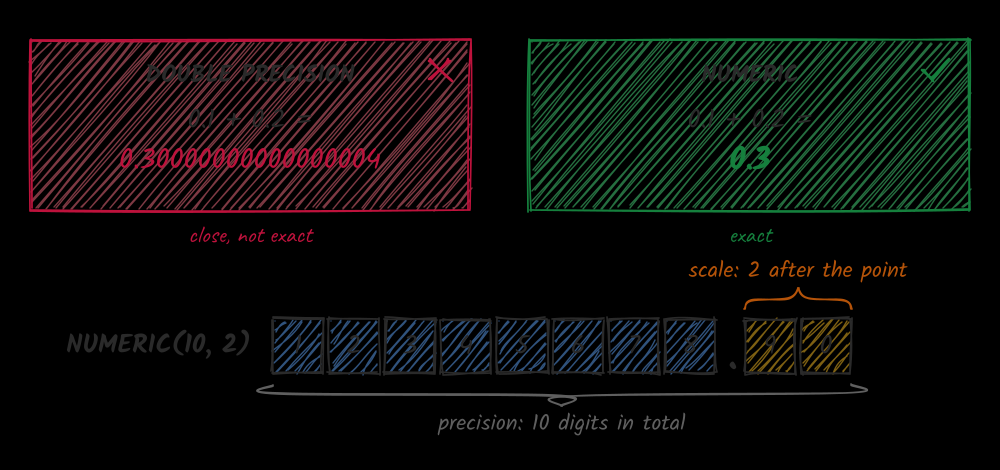
With NUMERIC, you can specify precision (total number of digits) and scale (number of digits after the decimal point). For example:
CREATE TABLE transactions (
    id SERIAL PRIMARY KEY,
    amount NUMERIC(10, 2) -- up to 10 digits, 2 of which are after the decimal
);
This ensures that no rounding errors creep into calculations, making it perfect for critical systems.
Key Features of NUMERIC
- User-Defined Precision and Scale
You can tailor the type to fit your specific requirements:
- NUMERIC(10, 2) allows values like 12345.67.
- Without specification, NUMERIC can hold any value with arbitrary precision.
- Guaranteed Accuracy
Unlike floating-point types (REAL, DOUBLE PRECISION), which approximate values, NUMERIC stores data exactly as entered. - Extensive Range
With a virtually unlimited range of values, NUMERIC can handle data that exceeds the capacity of standard integer types.
When to Use NUMERIC
The NUMERIC type is your go-to choice when precision is a top priority. Here are some specific scenarios:
- Finance
Calculating interest rates, balances, and taxes requires precision. Even tiny rounding errors can lead to significant discrepancies. - Scientific Research
Fields like physics or chemistry often demand exactness in measurements and calculations. - Compliance
Industries with regulatory requirements (e.g., healthcare, banking) may require the use of precise, non-approximated data storage.
Performance Considerations
While the NUMERIC type ensures precision, it comes with a trade-off: performance. It uses more storage than fixed-width types (INTEGER, BIGINT) and takes longer to process due to its flexible precision. For high-speed applications where slight inaccuracies are tolerable, floating-point types like REAL or DOUBLE PRECISION may be preferable.
To optimize performance:
- Use NUMERIC only when precision is required.
- Leverage indexes to speed up searches and calculations on NUMERIC columns.
Tips for Using NUMERIC Effectively
- Specify Precision and Scale Where Possible
Defining precision and scale not only improves clarity but also optimises storage.
CREATE TABLE orders ( order_id SERIAL PRIMARY KEY, total_price NUMERIC(15, 2) );
- Avoid Overusing It
Use NUMERIC sparingly for large-scale datasets that don’t need exact precision to save storage and processing power. - Combine with Constraints
Add constraints to ensure data integrity. For example:
CHECK (amount >= 0)
Conclusion
PostgreSQL’s NUMERIC type is a powerful ally for applications that demand precision. Its ability to handle arbitrary precision and scale makes it indispensable for fields like finance and science. However, it’s essential to balance its accuracy with the performance demands of your application.
By understanding the strengths and trade-offs of NUMERIC and its alternatives, you can make informed decisions that optimize both the reliability and efficiency of your database. For developers who value precision, NUMERIC is not just a data type—it’s peace of mind.
Originally published on Medium.